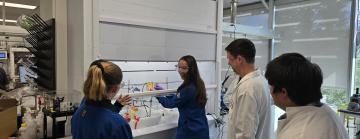
Research
Our research promotes the design and development of electrochemical and solar-driven technologies through improved understanding of the fundamental phenomena that govern (electro)chemical reactivity and charge transfer across interfaces.
We are experimentalists studying how these factors can be controlled and how they inform the design of durable, efficient next-generation energy technologies, including those that produce fuels, synthesize fine chemicals, purify water sources, and separate critical materials and minerals.
Advanced instrumentation and methodologies, supported by SLAC and the US Dept. of Energy, are a critical component of this research and enable us to observe the dynamics of these interfaces under operating conditions.
Read below for more on representative thrusts within the group!
Probing Electrocatalytic Interfaces
Catalysis underpins the production of the fuels and chemicals that are critical to modern society. As part of the SUNCAT Center for Interface Science and Catalysis, one of our primary areas of interest is in understanding the fundamentals that dictate these catalytic reactions. We focus on catalytic reactions that occur at electrified interfaces and that can be driven using electrical energy (e.g., solar, nuclear, wind). We are motivated by the idea that to efficiently harness the conversion of electrical energy to chemical fuels (and complex synthetic products) promises a more reliable, affordable, and resilient chemical and energy industry.
We study interfaces that drive many electrochemical reactions, including water splitting to produce H2, CO2 reduction, N2 reduction to NH3, and NO3- reduction. We build and analyze the performance of high-current devices (e.g., electrolyzers) and study the factors underpinning the durability (or lacktherof) under long-term operation.
Understanding these processes requires careful electroanalytical measurements as well as the design of advanced catalysts and reactors. The electrified interfaces at which electrocatalytic reactions occur is dynamic, and we use advanced instrumentation to observe these dynamics at the molecular level and with precise time resolution We use facilities including advanced synchrotron sources (at SLAC and around the world) and neutron scattering measurements (in collaboration with Oak Ridge National Laboratory).
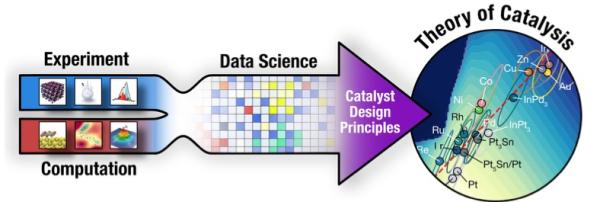
Our vision is to contribute to improved theories of catalysis that will enable the rational design of catalysis models with robust predictive capabilities for both efficiency and durability. Enabled by the SUNCAT collaboration and others, we work closely with theorists and data scientists to build these models. Machine learning and database development driven by SUNCAT promote next-generation data analysis, sharing, and reliability.
Recent representative publications:
Matthews, J. E.; Avilés Acosta, J. E.; Lee, S.-W.; Oh, D.; Lin, T. Y.; Yap, K. M. K.; Chen, J.; Jang, J.-W.; Lee, D. U.‡; Nielander, A. C.‡; Jaramillo, T. F.‡ Operando Surface-Enhanced Infrared Spectroscopy Connects Interfacial Dynamics with Reaction Kinetics During Electrochemical CO2 Reduction on Copper. ACS Catal. 2025, 15 (1), 381–391. https://doi.org/10.1021/acscatal.4c05532.
Benedek, P.; Cornejo-Carrillo, Y. E.; O’Rafferty, A. H.; Niemann, V. A.; Lee, S.-W.; McShane, E. J.; Cargnello, M.; Nielander, A. C.‡; Jaramillo, T. F.‡ Temperature-Dependent Solid Electrolyte Interphase Reactions Drive Performance in Lithium-Mediated Nitrogen Reduction to Ammonia. Joule 2025, 9 (3). https://doi.org/10.1016/j.joule.2024.101810.
Marin, D. H.; Perryman, J. T.; Hubert, M. A.; Lindquist, G. A.; Chen, L.; Aleman, A. M.; Kamat, G. A.; Niemann, V. A.; Stevens, M. B.; Regmi, Y. N.; Boettcher, S. W. ‡; Nielander, A. C. ‡; Jaramillo, T. F. ‡ Hydrogen Production with Seawater-Resilient Bipolar Membrane Electrolyzers. Joule 2023, 7 (4), 765–781. https://doi.org/10.1016/j.joule.2023.03.005.
Recent representative publications:
Yap, K. M. K.; Wei, W. J.; Rodríguez Pabón, M.; King, A. J.; Bui, J. C.; Wei, L.; Lee, S.-W.; Weber, A. Z.; Bell, A. T.; Nielander, A. C.‡; Jaramillo, T. F‡. Modeling Diurnal and Annual Ethylene Generation from Solar-Driven Electrochemical CO2 Reduction Devices. Energy Environ. Sci. 2024, 17 (7), 2453–2467. https://doi.org/10.1039/D4EE00545G.
Yap, K. M. K.; Lee, S. A.; Kistler, T. A.; Collins, D. K.; Warren, E. L.; Atwater, H. A.‡; Jaramillo, T. F.‡; Xiang, C.‡; Nielander, A. C.‡ Addressing Challenges for Operating Electrochemical Solar Fuels Technologies under Variable and Diurnal Conditions. Frontiers in Energy Research 2024, 12.
Schichtl, Z. G.; Carvalho, O. Q.; Tan, J.; Saund, S. S.; Ghoshal, D.; Wilder, L. M.; Gish, M. K.; Nielander, A. C.; Stevens, M. B.; Greenaway, A. L. Chemistry of Materials Underpinning Photoelectrochemical Solar Fuel Production. Chem. Rev. 2025, 125 (10), 4768–4839. https://doi.org/10.1021/acs.chemrev.4c00258.
Solar Fuels Science
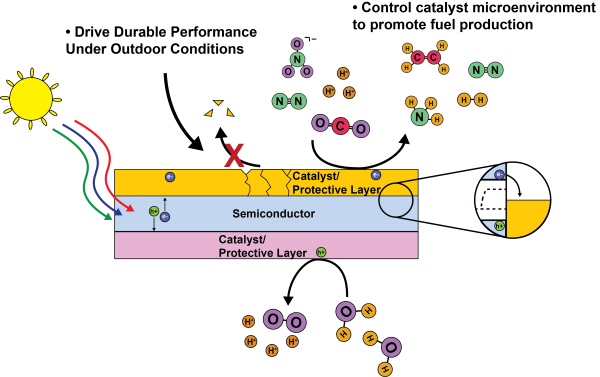
Storing sunlight energy as chemical fuel and using it to generate fine chemicals are grand challenges. Solar fuels science encompasses the many strategies that are under study to find ways to meet this challenge, and efficient conversion requires numerous synchronized processes (e.g., light absorption, charge separation, (electro)catalysis). Our team approaches this challenge using our expertise both in semiconductor physics and in (photo)electrochemical behavior to drive reduction of CO2 to carbon fuels, water splitting to generate H2, and synthesis of nitrogen-containing molecules.
We study the behavior of semicondutor/electrolyte interfaces, we study the factors that impact the durability of catalysts under the variable conditions enforced by day/night (i.e., diurnal) cycling, and we also model the behavior of solar fuels devices in response to these dynamic outdoor conditions.


