Strange Group X-ray Capabilities
The following capabilities were developed specifically for use at SSRL. Some of these capabilities are available through the SSRL general user program, whereas others are only available through collaborations with the Strange research group.
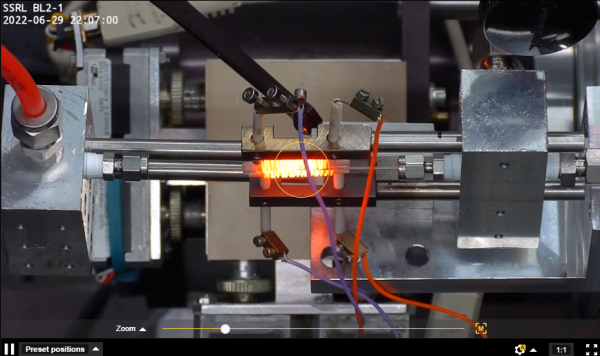
High Temperature X-ray Scattering and Spectroscopy (Capillary cell)
- Nichrome (20-800 °C) or Kanthal (1000+ °C) heating coils are available for capillary sample heating
- Available capillaries are glass (20-500 °C), quartz (20-1000 °C) or single crystal sapphire (20-1000+ °C)
- Compatible with gas flow environments*
Low Temperature X-ray Scattering and Spectroscopy (Capillary cell)
- Sample cooling is possible using an Oxford Instruments Cryojet. Set point temperatures are available as low as 90 °C (note: thermal gradients are common when cooling sealed capillaries and yield sample temperatures closer to 120 °C).
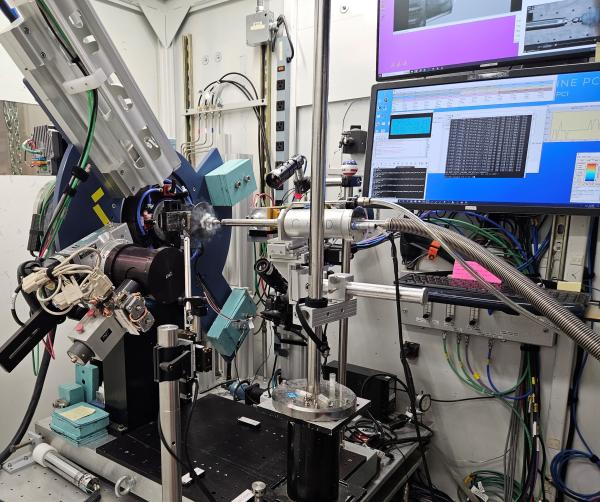
Low Temperature X-ray Scattering (Closed cycle He cryostat)
- APD , DE 204 CCR
- 10-300 K
- Be windows restrict gas dosing to ambient and sub-ambient pressures
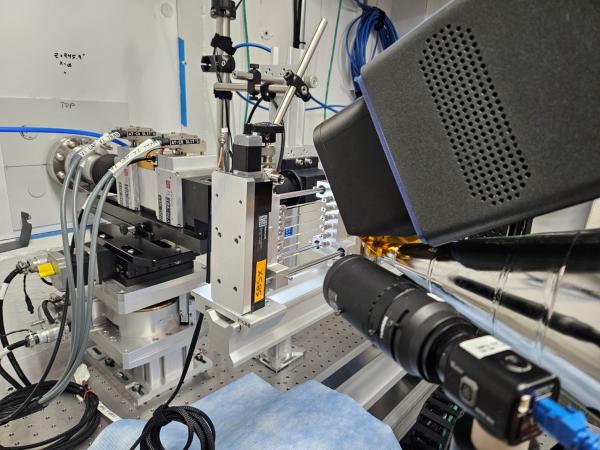
Multi-capillary sample cell
- 6 capillaries under identical conditions
Focus on high throughput gas exposures
Configurations for in situ X-ray Scattering measurements in capillaries
1 or 0.5 mm o.d. (0.01 mm wall) drawn quartz capillaries epoxied into an aluminum support frame
- 200 – 300 K (orthogonally mounted Oxford N2 Cryojet)
- 300 – 873 K (Nichrome heating coils)
- 10-7 mbar to 10 bar gas pressures
- Compatible with gas flow
- Compatible with sample loading in a glovebox
Advantages: Best option for minimizing silica background
Disadvantages: Involved sample preparation, limited heating due to epoxy seal, variability in capillary diameter and wall thickness due to drawing process (bad for SAXS backgrounds)
1 mm o.d. (0.1 mm wall) extruded quartz capillary sealed with graphite ferrules
- 200 – 300 K (orthogonally mounted Oxford N2 Cryojet)
- 300 – 1273 K (Nichrome or Kanthal heating coils)
- Compatible with gas flow (usually operates slightly overpressured to minimize potential leaks)
Advantages: Fastest setup for variable temperature measurements in air/inert gas, higher temperatures possible with graphite ferrules, capillaries display more uniform diameters and wall thicknesses due to extrusion (good for SAXS backgrounds)
Disadvantages: Poor reliability of sealing due to thin walls
1.1 mm (0.115 mm wall) soda lime glass capillaries sealed with graphite ferrules
- 100 – 300 K (parallel mounted Oxford N2 Cryojet)
- 300 – 673 K (Nichrome heating coils)*
- 10-7 mbar to 200 bar gas pressures
- Compatible with gas flow
- Compatible with sample loading in a glovebox
- Can be flame sealed at one end for static measurements
Advantages: Low cost, reproducible backgrounds for SAXS, high pressure compatible
Disadvantages: Thick capillary walls generate strong silica background, limited heating capabilities, higher concentrations of Ca, Na, and K than quartz, Pyrex, or standard glass grades
*consider sample reactivity with silica at high temperatures
1.0922 mm o.d. (0.043 mm wall) single crystal sapphire capillaries sealed with graphite ferrules
- 200 – 300 K (orthogonal mounted Oxford N2 Cryojet)
- 300 – 1273 K (Nichrome/Kanthal heating coils)*
- 10-7 mbar to 200 bar gas pressures
- Compatible with gas flow
- Compatible with sample loading in a glovebox
Advantages: High pressure and temperature compatible
Disadvantages: Single crystal sapphire (capillary length grown along c-axis) can generate Bragg spots onto detector/in background, long lead times for re-ordering
*consider sample reactivity with alumina at high temperatures
Considerations for in situ capillary XRD measurements
- Capillaries can rock about the long axis, but do not spin
- Better powder averaging can be achieved by using a larger capillary diameter if the sample allows
- Materials containing elements with high atomic number(s) and crystalline densities should use smaller o.d. capillaries to reduce absorption effects (see APS absorption calculator for estimation)
Ancillary Equipment
Mass Flow Controllers:
- 1000 sccm (3)
- 500 sccm
- 200 sccm
- 100 sccm (2)
- 10 sccm
Gases available through SSRL inventory (Supplies of N2, He, and Ar are maintained on site) or the ordering process
Teledyne ISCO Syringe Pump
- Capable of pressurizing gases to ~650 bar
- Measurement of gas effluent mass spectrum below 200 amu[NS2]
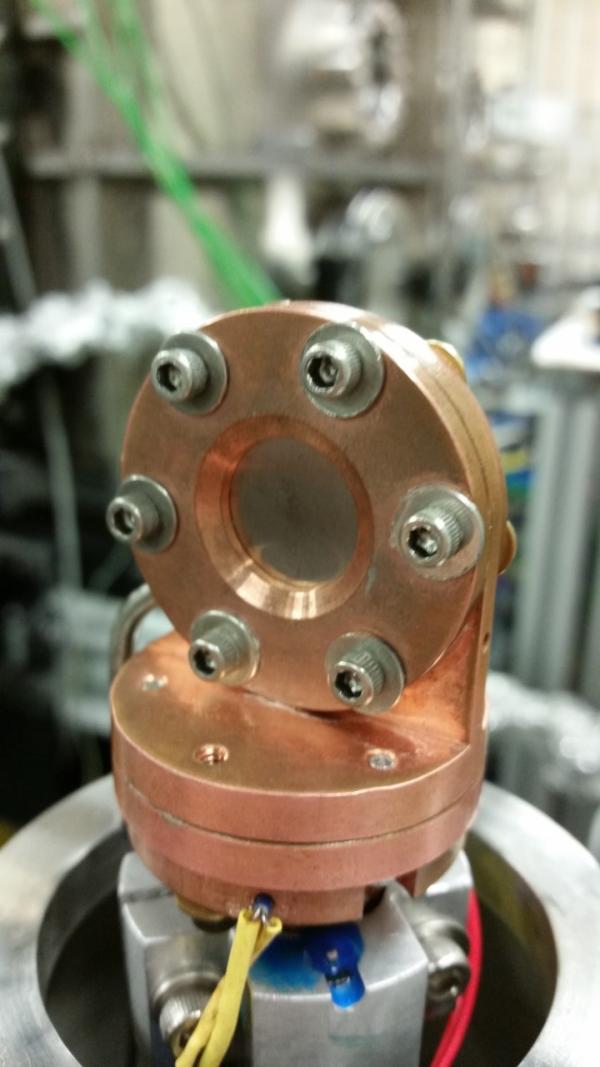
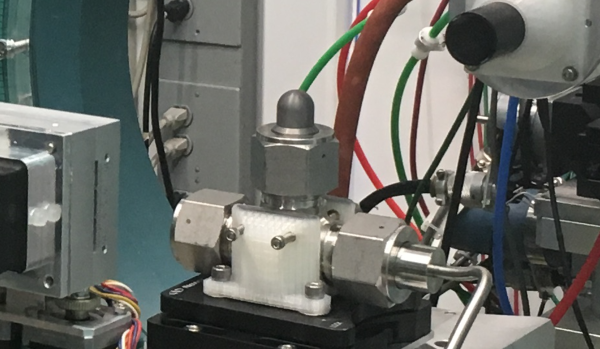
Variable Pressure X-ray Scattering and Spectroscopy (Be domed cell)
- Flat plate sample geometry
- Gas pressures up to 80 bar
- Limited heating capabilities
*Gas flow: Multiple MFCs with 10, 100, 200, 500, 1000 sccm full scale values


